MOST TRADING SYSTEMS WERE BUILT FOR THE WRONG MARKET
Many people approach trading backwards.
They look for strategies first.
Indicators. AI. Bots. Systems. Signals.
Whatever happens to be popular at the time.
Then they try to force those systems onto market environments they were never designed for.
Markets are not static, they change.
Sometimes slowly, sometimes violently.
And here is the real problem:
When the environment changes, most trading systems continue operating as if nothing happened.
That is why so many systems eventually fail.
Not necessarily because the strategy itself is bad.
But because the market conditions the strategy was built for no longer exist.
To us, the real edge in trading is not finding a magical strategy.
It’s identifying moments when market conditions fundamentally change.
Especially when those changes are driven by larger macroeconomic and geopolitical forces likely to persist for years.
Then building specifically for that environment.
Timing comes first, the system comes second.
That is the foundation of our ‘condition-centric’ methodology.
One market that stood out to us was gold.
For years, gold typically moved in average daily ranges of roughly $30–$60.
Then came April 3, 2025.
After Donald Trump announced the “Liberation Day” tariffs on April 2, 2025, gold volatility expanded dramatically.
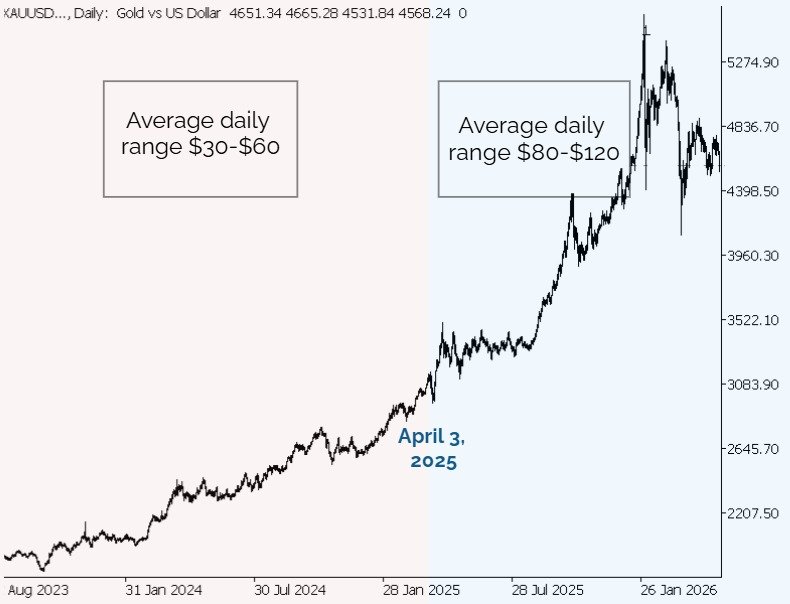
Geopolitical instability, debt concerns, pressure on central banks, and growing uncertainty across global markets only accelerated the expansion.
Importantly, we are not referring to trend direction here.
We are referring to the expansion in daily movement, volatility, and overall market behavior.
Suddenly, daily ranges above $100 became common.
And unlike most volatility spikes, the behavior persisted.
That mattered.
Because it suggested something more structural was taking place.
And when market conditions fundamentally shift, the opportunity is no longer in prediction.
The opportunity is in recognizing the shift early and building specifically for it.
The objective was not to create a “magic bot.”
Markets evolve too much for that.
The objective was to build around a market environment showing unusually favorable characteristics.
Conditions we believed had a high probability of persisting while the underlying macro environment remained in place.
As long as Trump remains in office, we believe those broader conditions are likely to persist.
By the time most systems adapt, the opportunity that created the edge is often already gone.
Most systems require long periods of historical confirmation before adaptation takes place.
But modern market environments can change far faster than those adaptation cycles were designed for.